Internet Protocol Version 6 (Ipv6) Zero-To-Hero
This post was published 3 years ago. Download links are most likely obsolete. If that's the case, try asking the uploader to re-upload.

Published 3/2023
MP4 | Video: h264, 1280x720 | Audio: AAC, 44.1 KHz
Language: English | Size: 7.59 GB | Duration: 19h 30m
Concepts , Configuration
What you'll learn
IPv6 Address Fundamentals
IPv6 Address Simplification Rules
IPv6 Address Types
IPv6 Multicast Address
IPv6 Unicast Address Types - Unspecified and Loopback
IPv6 Unicast Address Types - Unique Local Address
IPv6 Unicast Address Types - Link Local Address
IPv6 Unicast Address Types - Global Unicast Address
IPv6 Unicast Address Types - GUA Subnet Prefix
IPv6 Unicast Address Types - Embedded IPv4
IPv6 Global Unicast Address Manual Configuration
IPv6 Unicast Routing
IPv6 Dynamic Address Assignment - SLAAC
IPv6 Router Address Assignment with SLAAC
IPv6 Path MTU Discovery (PMTUD)
IPv6 Dual Stack Migration Strategy
IPv6 Tunneling - MCT with Static Routing
IPv6 Tunneling - MCT with Dynamic Routing
IPv6 Tunneling - GRE
IPv6 Tunneling - Automatic 6to4 ( Private Address )
IPv6 Tunneling - Automatic 6to4 ( Public Address )
IPv6 Tunneling - ISATAP
IPv6 NAT64 Introduction
IPv6 Static NAT64
IPv6 NAT64 with DNS64
IPv6 Deployment Models
IPv6 and IPv4 Characteristics
IPv6 Enhancements over IPv4
Requirements
You need to have knowledge of Cisco IOS CLI configuration . You can implement scenarios of this course in GNS3 and EVE-NG.
Description
Internet Protocol version 6 (IPv6) is the most recent version of the Internet Protocol (IP), the communications protocol that provides an identification and location system for computers on networks and routes traffic across the Internet. IPv6 was developed by the Internet Engineering Task Force (IETF) to deal with the long-anticipated problem of IPv4 address exhaustion, and is intended to replace IPv4. In December 1998, IPv6 became a Draft Standard for the IETF, which subsequently ratified it as an Internet Standard on 14 July 2017.Devices on the Internet are assigned a unique IP address for identification and location definition. With the rapid growth of the Internet after commercialization in the 1990s, it became evident that far more addresses would be needed to connect devices than the IPv4 address space had available. By 1998, the IETF had formalized the successor protocol. IPv6 uses 128-bit addresses, theoretically allowing 2128, or approximately 3.4×1038 total addresses. The actual number is slightly smaller, as multiple ranges are reserved for special use or completely excluded from use. The two protocols are not designed to be interoperable, and thus direct communication between them is impossible, complicating the move to IPv6. However, several transition mechanisms have been devised to rectify this.IPv6 provides other technical benefits in addition to a larger addressing space. In particular, it permits hierarchical address allocation methods that facilitate route aggregation across the Internet, and thus limit the expansion of routing tables. The use of multicast addressing is expanded and simplified, and provides additional optimization for the delivery of services. Device mobility, security, and configuration aspects have been considered in the design of the protocol.
Overview
Section 1: Introduction
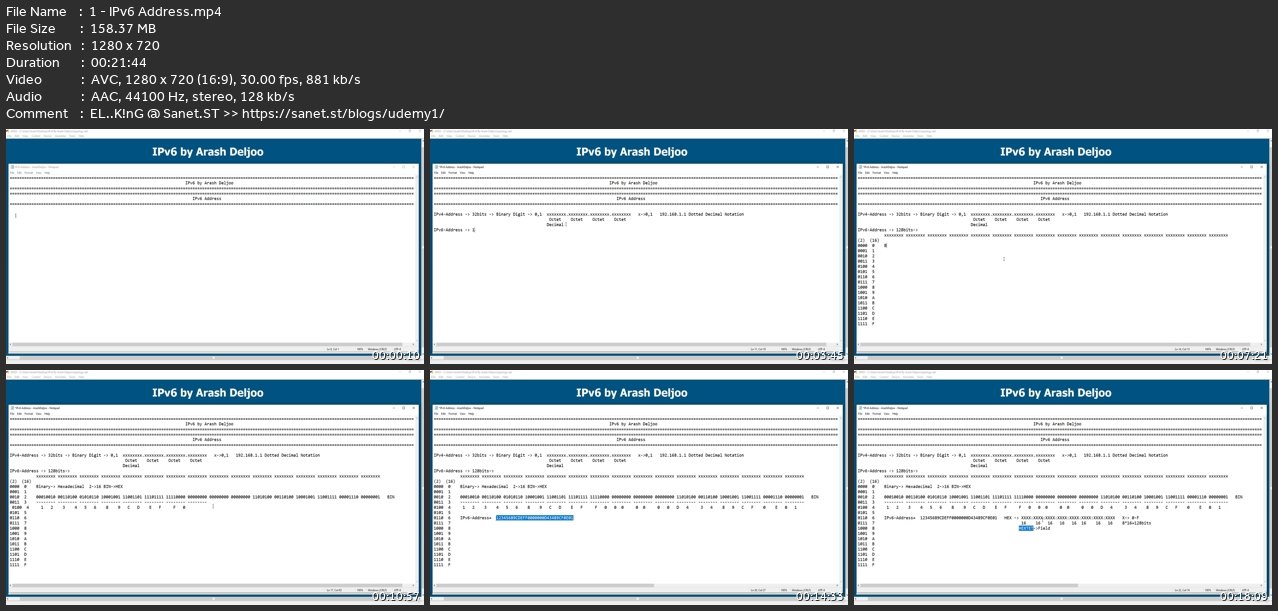
Lecture 1 IPv6 Address
Lecture 2 IPv6 Address Simplification Rules
Lecture 3 IPv6 Address Types
Lecture 4 IPv6 Multicast Address
Lecture 5 IPv6 Fundamentals and Multicast IPv6 Address Review
Lecture 6 IPv6 Unicast Address Types - Unspecified and Loopback
Lecture 7 IPv6 Unicast Address Types - Unique Local Address
Lecture 8 IPv6 Unicast Address Types - Link Local Address
Lecture 9 IPv6 Unicast Address Types - Global Unicast Address
Lecture 10 IPv6 Unicast Address Types - GUA Subnet Prefix
Lecture 11 IPv6 Unicast Address Types - Embedded IPv4
Lecture 12 IPv6 Anycast and ULA , LLA Address Review
Lecture 13 IPv6 Global Unicast Address Manual Configuration
Lecture 14 IPv6 Unicast Routing
Lecture 15 IPv6 Dynamic Address Assignment - SLAAC
Lecture 16 IPv6 Router Address Assignment with SLAAC
Lecture 17 IPv6 Stateless DHCP and Stateful DHCP and NDP and DAD
Lecture 18 Global Unicast IPv6 Address Fundamental and Assignment Review
Lecture 19 IPv6 Routing Fundamentals and Static Routing
Lecture 20 IPv6 Path MTU Discovery (PMTUD)
Lecture 21 IPv6 Dual Stack Migration Strategy
Lecture 22 IPv6 Tunneling - MCT with Static Routing
Lecture 23 IPv6 Tunneling - MCT with Dynamic Routing
Lecture 24 IPv6 Tunneling - GRE
Lecture 25 IPv6 Tunneling - Automatic 6to4 ( Private Address )
Lecture 26 IPv6 - Tunneling - Automatic 6to4 ( Public Address )
Lecture 27 IPv6 Tunneling - ISATAP
Lecture 28 IPv6 NAT64 Introduction
Lecture 29 IPv6 Static NAT64
Lecture 30 IPv6 NAT64 with DNS64
Lecture 31 IPv6 Deployment Models
Lecture 32 IPv6 and IPv4 Characteristics
Lecture 33 IPv6 Enhancements over IPv4
Lecture 34 IPv6 Design - IPv6 Deployment and Design Considerations
Lecture 35 IPv6 Design - Considerations for Migration to IPv6 Design
Lecture 36 IPv6 Design - IPv6 Transition Mechanisms[A]
Lecture 37 IPv6 Design - IPv6 Transition Mechanisms[B]
Lecture 38 Challenges of the Transition to IPv6 - IPv6 Services
Lecture 39 Challenges of the Transition to IPv6 - Link Layer Security Considerations
Enterprise Network Engineers , Service Provider Engineers , Datacenter Engineers
Screenshots
Homepage
without You and Your Support We Can’t Continue
Thanks for Buying Premium From My Links for Support
Click >>here & Visit My Blog Daily for More Udemy Tutorial. If You Need Update or Links Dead Don't Wait Just Pm Me or Leave Comment at This Post
Quick check before we show the links
Helps us keep automated scrapers from hammering the filehosts.