SWI-Prolog v7.2.3 (x86/x64) Stable + v7.2.2 Portable
This post was published 10 years ago. Download links are most likely obsolete. If that's the case, try asking the uploader to re-upload.
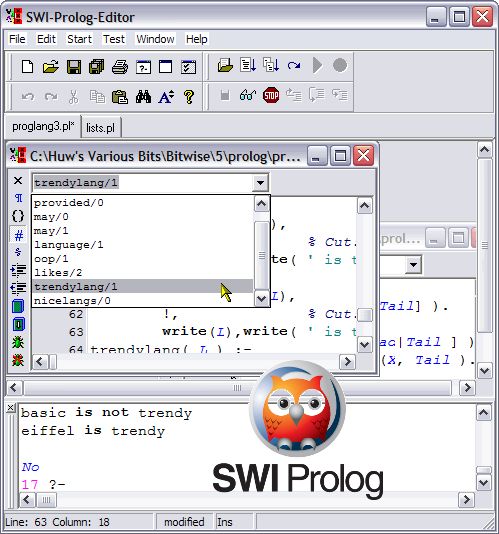
SWI-Prolog v7.2.3 (x86/x64) Stable + v7.2.2 Portable | 13.2/19.6/10.2 Mb
SWI-Prolog provides you with a comprehensive and robust development environment for the Prolog logic programming language, which is intended for computational linguistics and artificial intelligence applications. Relying on a Prolog virtual machine to define instructions, SWI-Prolog features a faster compiler and the debugging mode only reduces the system speed by a bit.
The application comes with a flexible and intuitive interface that enables you to work with C / C++ code, providing support for large applications and unlimited integer values without lowering performance.
Both static and dynamic code can be easily indexed on any argument, while the source-level debugger supports graphics through XPCE.
SWI-Prolog bundles a Prolog cross-referencer, an execution profiler to output instruction statistics, as well as an error checking tool. The package also includes a collection of libraries that programmers can find useful, namely components for constraint handling rules, interface libraries, HTML, RDF and XML parsers, a web server library for session management, HTML and HTTP authorization endeavors and so on.
The advanced debugging feature set comprises a spy point editor, an exception debugger, a thread monitor and a dependency management tool.
The program provides support for unicode character sets, which makes it suitable for creating web-based and multilingual applications.
Multi-threading support (run multiple prolog engines on the same database), compiled code tracing, a set of specialized instructions and built-in predicates, attributed and global variables, unit testing using PiDoc, support for creating LaTeX documentation are other advantages that this application brings you.
Featuring high compilation speed, SWI-Prolog can be of great use for Prolog programmers. Its array of features are enough to please the experienced users, since advanced programming knowledge is required in order to use it.
FEATURES
Fast compilation
• E.g., loads 140,000 lines of code spread over 500 source-files in 2.3 seconds on an AMD 5400+ system.
• Robust and free of memory leaks. In use for several servers that run 24x7 (including this web-service).
Small
• The full development environment, including graphics, libraries and many interface packages requires approx. 40MB harddisk. The non-graphical kernel is about 650Kb, the graphics library adds about 1.2Mb to the image.
Scales well for large applications:
• No limits on program size, atom-length, term-arity or integer values. No performance degradation on predicates with many (indexed) facts.
• Just-In-Time indexing of both static and dynamic code on any argument greatly simplifies handling multi-moded relations with many clauses.
• Unbounded integer and rational number arithmetic based on GMP library.
• Comprehensive set of built-in predicates, covering Part 1 of the ISO standard, the de-facto Edinburgh Prolog standard and important parts of Quintus and SICStus Prolog. Fair compatibility to Ciao, YAP and GNU-Prolog.
• Flexible and fast interface to the C- and C++-Language. The interface allows for calling both-ways, handling of non-determinism both ways and embedding of the SWI-Prolog kernel in C/C++ projects.
The goodies
• modules (upward compatible to Quintus and SICStus), garbage-collection (transparent to C/C++-code, including atom garbage collection), last-call optimisation, Dynamic expansion of the runtime stacks, ISO exception-handling (including C/C++ interface for catching and throwing exceptions).
• Source-level debugger on all platforms that supports graphics through XPCE
• Execution profiler (time and call statistics)
• Cross-Referencer. gxref/0 provides a graphical front-end for the extensible Prolog cross-referencer (xref).
• Sources are plain C99, configured automatically using GNU autoconf (configure, make, make install).
• UNICODE character set handling internal. Ideal for web- and international applications.
• Machine-independent saved-states (save on one platform, run using the virtual machine of another platform).
• Multi-threading support: run multiple pre-emptively scheduled prolog engines on the same database.
• attributed variables, coroutining (freeze/2, when/2, dif/2), global variables, cyclic terms.
• Flag-controlled handling of occurs-check (false/true/error) see current_prolog_flag/2.
• Constraint Logic Programming, providing libraries for CHR (Constraint Handling Rules), clp(FD), clp(R,Q) and various others.
• Bundled with interface libraries for Java (JPL), ODBC, TCP/IP sockets, SSL, CGI form handling, etc. Check the packages.
• Multi-threaded Web server library with comprehensive libraries to generate HTML, HTTP authorization, session management, exchanging JSON (used by many AJAX widgets), etc.
• Fast and flexible libraries for parsing SGML/XML (HTML), parsing RDF, store and query the RDF triple model. A graphical editor for RDF/RDFS and OWL models called Triple20 is distributed seperately.
• Literate programming support through PlDoc. Provides integrated view on manual and application documentation and producing LaTeX documentation for your application.
• Unit testing support through PlUnit.
OS: Windows XP / Vista / 7 / 8 (32/64-bit)