Migrating to microservice databases: from relational monolith to distributed data
This post was published 6 years ago. Download links are most likely obsolete. If that's the case, try asking the uploader to re-upload.
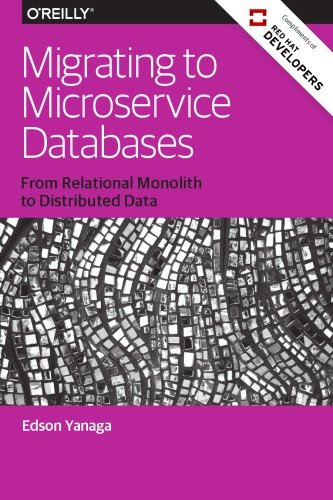
2017 | ISBN: 978-1-491-97461-2 | English | 258 pages | PDF | 5 MB
After years of researching, coding, and talking about microservices, Edson Yanaga—Red Hat’s Director of Developer Experience—hears one question frequently: how do I evolve my monolithic legacy database? In this practical report, Yanaga explains strategies for dealing with your relational database when migrating from a monolithic codebase to a microservices architecture. In the process, you’ll focus on one key microservices characteristic: decentralized data management.
For many enterprise application developers, microservices are good for splitting up unwieldy codebases into smaller, well-defined, cohesive, and loosely coupled artifacts—an architecture that can simplify and accelerate new software releases. You’ll learn successful strategies for integrating data between your existing monolithic application and your new microservice artifacts.
• Learn how zero downtime migrations enable you to deploy new code without disrupting user activity
• Evolve your relational database by keeping specific versions of application code and database schemas in the same code repository
• Understand the distinction behind the CRUD pattern and CQRS—including the consistency models involved in distributed systems
• Explore a set of nine strategies for integrating data from your monolithic application to a microservice architecture
Quick check before we show the links
Helps us keep automated scrapers from hammering the filehosts.
For those who may have missed recent events: the switch to premium-only links on Nitroflare was not a decision made by the site administration or the post uploaders. This change was implemented by the file hosting service itself.
We know many of our regular users still use Nitroflare and have active subscriptions, so we won't be removing it. However, we do plan to update our posting rules for uploaders in the near future to better adapt to the situation.
Thank you for your understanding and continued support.