Agroforestry and Climate Change
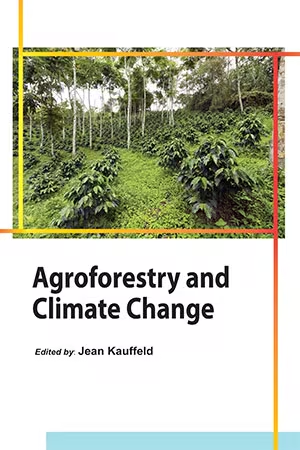
Jean Kauffeld | 2023 | ISBN: 1682508420 | English | 292 pages | True PDF | 14 MB
Climate change is expected to result in more erratic precipitation patterns that will ultimately lead to higher soil erosion rates. Where rainfall amounts increase, erosion and runoff will increase at an even greater rate: the ratio of erosion increase to annual rainfall increase is on the order of 1.7. Agroforestry is increasingly recognized as a land management system that can serve as a response option for both climate change adaptation and mitigation, while addressing many of the challenges that smallholder farmers are facing. Agroforestry can generate multiple livelihood and environmental benefits, as it can help to mitigate climate change and help farmers to adapt to extreme and variable weather. Agroforestry supports tree-related ecosystem services, such as regulation of water and sediment flows, carbon and nutrient cycling in soils and it provides habitat for biodiversity. This leads to increased soil fertility, reduced soil erosion and flood and pest control. Benefits of agroforestry to smallholder farmers include increased farm productivity and reduction of external inputs such as conventional fertilizers and chemicals for pest management, leading to increased income. Reviewing on the potential effect of agroforestry practices on climate change mitigation and adaptation through sequestrating carbon and modifying soil profile to have higher organic matter (OM) is critical.
The information in this book covers different agroforestry practices in reducing climate change impacts in different area of the world. This book explores the role of forests and trees in climate-smart agriculture (CSA). It takes into consideration the ecosystem services and goods that forests provide, and the importance of forests for the food security of forest-dependent people. It explores the complex relationship between climate change and forests, and how adaptation and mitigation measures can benefit forests, forest-dependent people, and global climate change. Agroforestry practice is a promising practice to sequester carbon while providing enormous environmental, economical, and social benefits.
This shows significant carbon accumulation in living biomass carbon, as well as soil carbon, demonstrating the potential to offer the environmental service of carbon sequestration. Climate change can increase risk for agriculture such as droughts, flooding and pests. Farming is not only affected by the impact of climate changes, but it's also a significant contributor to global greenhouse gas emissions. Intensive farm practices that include both farm production and change of land use, directly affect the global carbon, water, and nutrient cycles. Farming, as a direct driver for 80% of global deforestation, also releases significant amounts of greenhouse gasses. Furthermore, as forests continue to be cleared, the land is directly exposed to wind and water soil erosion. The ability of farmers to continue living on their land depends on how well they adapt to climate change risks. Agroforestry for climate adaptation at the farm level and enhanced resilience at the landscape level can take many forms. Agroforestry can reduce air pollution and enhance both warming and cooling of the atmosphere, creating a resilient microclimate for crops and livestock.
Quick check before we show the links
Helps us keep automated scrapers from hammering the filehosts.